Imagine You Are Following Ther Population Biolgy of a Aspecies and Wnat to Know if
The questions "What are species?" and "How do nosotros place species?" are difficult to answer, and have led to fence and disagreement amongst biologists. Run into how consensus on answers to these questions can steer global, political, and financial pressures that affect conservation efforts.
Most people have a basic idea of what species are, fifty-fifty if they are not sure of the best way to define the word species. Quite simply, species are kinds, or types, of organisms. For example, humans all belong to ane species (the scientific proper name of our species is Homo sapiens), and we differ from other species, such as gorillas or dogs or dandelions. But defining, identifying, and distinguishing betwixt species really isn't that elementary. In fact, information technology is often a complex and difficult process-especially in cases of new or previously unknown species. Biologists oft disagree about species, and even argue over how best to define the discussion species. This disagreement is so well known, and so much discussed, that it is sometimes referred to by biologists as the "species trouble" (Hey 2001).
This article explores the idea of species, including both the significant of the word species, and how biologists think species tin be identified in nature. It also examines why an understanding of species is of import, both for the written report of biology and for our society.
Why Are Species So Confusing?
The central difficulty when studying species is that, even though all species are kinds of organisms, all kinds of organisms are not species. For example, birds are a kind of organism, only birds are not a species --there are many thousands of species of birds. For scientific purposes, it is not enough to identify a kind of organism. As a biologist you must also determine what level or rank of kind to assign to an organism. If yous discover a new kind of organism then you must decide if it should be called a new species, or if it falls inside an already described species. For example, the common chimpanzee species, Pan troglodytes, appears to include several slightly different kinds of chimpanzees. Each of these have been given the rank of sub-species. Alternatively, a newly discovered kind of organism might be so different from other known species that information technology receives not only a designation equally a new species simply as well a ranking as a new genus.
To aid understand the confusion and incertitude over species, let'south look at the well-nigh basic thought of Darwin'south theory of evolution by natural choice. Darwin figured out a procedure past which species could alter over fourth dimension, and he believed that development was a irksome and gradual process that played out over eons of time. So if species are irresolute slowly, and if new species are formed at the tedious pace of development, then we absolutely expect there to exist cases where we struggle to decide whether two kinds of organisms should be grouped as separate species or as a unmarried species. In his volume, On the Origin of Species, Darwin famously wrote, "I was much struck how entirely vague and arbitrary is the distinction between species and varieties." (Darwin 1859). In other words, Darwin did not believe that at that place was a definite betoken at which a species came into existence. Finally, because the large bulk of species come into existence gradually, it is not surprising that we accept difficulty deciding when to identify new species or what the all-time way to exercise so should be.
What Is a Species? How Do We Know a Species When We Find I?
Imagine you lot're a biologist on a research trek to look for previously undiscovered kinds of butterflies. If y'all detect some butterflies that seem different from those species that are already known (Effigy i), and then you are faced with two questions. The first question is "what are species?", or to put information technology another manner, "what makes a kind of butterfly an bodily species of butterfly, rather than a sub-species or a genus?" The second question is "how should a species be detected?" The answer to this 2nd question depends on the answer to the first question (i.e. "what are species?") only the two questions are non the aforementioned.
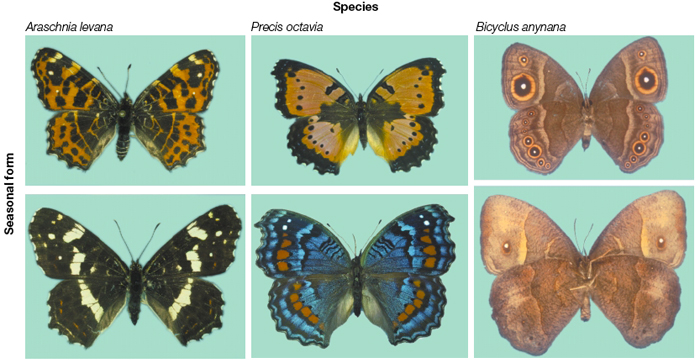
Figure 1: Variation within species
Within the same species, individual organisms can look very different. For all three species of butterflies, wing color and pattern varies depending on the season during which they were born. The butterflies at the top were built-in under different temperature and light atmospheric condition than the ones at the lesser.
A. levana and P. octavia photos courtesy of Fred Nijhout, Duke University, North Carolina, U.s.. B. anynana photos courtesy of Dr. Paul Brakefield. All rights reserved. 
This business of having split up "what" and "how" questions near species is part of the confusion around species (de Queiroz 2005). In the past nearly biologists thought that knowing what species are (i.e., having an answer to the "what" question) was basically the aforementioned as knowing how to discover species (i.e., having an answer to the "how" question). The two questions are closely connected, but they are not really the same thing. For case, biologists might have a theoretical thought of what species are as well as a practical process for identifying species. The theoretical idea addresses the "what" question, while the practical procedure addresses the "how" question. It is possible that different scientists share the same theoretical idea about species, just actually rely upon different applied procedures for identifying them. The situation is similar to what a physicist faces when trying to notice unseen particles. The physicist may know what an electron is, but that is not the same as knowing how to detect an electron. The theoretical idea of the electron, when it is put into practical applications, has yielded multiple means to observe electrons. In the same way there are multiple means to observe species, and some may be amend than others depending on circumstances.
Two Archetype Viewpoints on What Constitutes a Species
Biologists struggled with questions on species identification even earlier Darwin introduced his theory of evolution by natural choice. And then, when Darwin showed how species change over time, species-related questions became fifty-fifty more difficult. In the mid-1900s the leading evolutionary biologists, Ernst Mayr and George Thou. Simpson, contributed ii key ideas about the basic nature of species.
Ernst Mayr: Members of a Species Share Reproduction
In 1942 the famous biologist, Ernst Mayr claimed that what makes species different from sub-species and genera is that the organisms within a species tin reproduce (i.east., produce fertile offspring) with i another, and that they cannot reproduce with organisms of other species (Mayr 1942). Mayr believed that individuals of the aforementioned species recognize each other equally potential mates and are able to produce fertile offspring, merely individuals of different species will either not endeavor to reproduce with one another, or if they try they will not produce fertile offspring. The effect of this reproductive barrier is that different species do not exchange genes with each other and therefore evolve separately from each other. Mayr was not the first to state that this belongings of shared reproduction within species (and lack of reproduction between species) is what makes species dissimilar from genera and sub-species. Merely more other biologists, Mayr emphasized using reproduction as the basis of species identification (come across below); and more than near biologists before him, Mayr placed a strong emphasis on reproductive separation between species.
Did Mayr get it right? Is sexual reproduction the true essence of species? One significant problem with Mayr'southward idea is that some organisms, like leaner and some eukaryotes, do not engage in sexual reproduction. For these organisms Mayr's ideas just do non employ. Just kinds of not-sexual organisms practise exist, and biologists have divided them into a broad variety of different types or species, such as the thousands of species of leaner that take been described. In these cases Mayr's idea that sexual reproduction defines species clearly is non appropriate. Just for sexual organisms, such as most animals, plants, fungi and protists, Mayr's idea has been very useful.
George Chiliad. Simpson: Members of a Species Share an Evolutionary Procedure
Some other idea was articulated past George Grand. Simpson. He said that something fifty-fifty more key about species than Mayr's idea of shared reproduction is at work; that the members of a species accept shared in an evolutionary process and an evolutionary history (Simpson 1951). Simpson's key thought is that a species is an evolutionary lineage that has evolved separately from other species. In other words, the organisms within a species all share in the processes of evolution. The processes of evolution, including genetic drift, migration and adaptation, crusade in that location to be a thing, an entity made up of organisms evolving in concert and that collectively form a species (Templeton 1989).
Chiefly, this belongings of evolving together does not apply to kinds of organisms to a higher place the species level. For example, birds are not evolving all together. In that location are many carve up species of birds, each of which is on its own evolutionary path. The same goes for mammals and plants, and indeed for any inclusive kind of organism that includes multiple species. One nice point about the general idea of a species as an evolving unit is that it fits those organisms - such as many bacteria and some eukaryotes - that do not engage in sexual reproduction.
Mayr'south and Simpson's Ideas Today
For the most part, biologists agree that species are fabricated up of organisms that are evolving together. And they also agree that for sexual organisms, shared reproduction inside species and the development of reproductive barriers between species, are major factors that cause species to exist. Where biologists tend to disagree is how these full general theoretical ideas should translate into methods for detecting and identifying species. In other words, biologists agree that these ideas help the states respond the question of what species are, but they are not in agreement about how much these ideas aid answer the question of how to identify species.
Identifying Species with the Biological Species Concept
For Ernst Mayr the answer to the question of how species are identified also boiled down to reproduction. In other words, Mayr was using the idea of reproductive separation of species to reply both the "what" and the "how" questions about identifying species (Mayr 1957). To Mayr, the primal to identifying species is determining whether at that place is shared reproduction inside a population of organisms and whether in that location are barriers to reproduction with other organism. Mayr chosen this idea of defining species on the basis of reproduction the Biological Species Concept, or BSC.
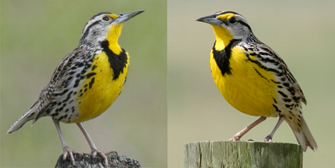
Figure 2: Western meadowlark and eastern meadowlark: two distinct species
Even though they expect alike and have overlapping ranges, the western meadowlark, Sturnella magna (left), and the eastern meadowlark, Sternella neglecta (right), have distinctly different songs. As a result, they practise non interbreed and are classified as split up species.
The BSC has been very widely discussed and debated, and many biologists think that Mayr is essentially correct about what species are and how they should be identified. For example, while the western meadowlark and eastern Meadowlark of the U.Due south. (Figure two) are very like in appearance and have overlapping geographic ranges, their distinctly unlike songs prevent them from interbreeding. Under BSC rules they are classified equally two different species. In this case, using the BSC to determine whether you take one or more than than one species is very straightforward. However, in many BSC cases, the decision is non straightforward at all. This is specially truthful if you're trying to determine whether two split populations in dissimilar geographic locations belong to the same species. When geographical separation is involved, the individuals in the unlike populations take no take a chance to reproduce with each other. If the populations cannot collaborate under natural conditions yous cannot know for certain if they would reproduce. Bogus conditions such as zoos and laboratories are non a valid style to decide whether individuals will reproduce in the wild, since members of a broad diverseness of species will reproduce with those of other species in a zoo, but not in their natural habitat.
The Phylogenetic Species Concept Is an Alternate Approach
Considering of the limitations of using the BSC to make decisions about species, many biologists have proposed other ways to identify species. 1 popular approach is called the Phylogenetic Species Concept , or the PSC (Rosen 1979; Cracraft 1983; Donoghue 1985). There are really several versions of the PSC, only they all hold that species can exist identified on the basis of shared traits. A grouping of organisms that all share 1 or more features pointing to a unique common antecedent, which in turn is not shared by members of other species, would see the criterion of species under the PSC. The traits used nether the PSC are wide ranging and include color or shape, or beliefs. For example, species of plants could exist distinguished on the basis of the color and shape of their flowers.
Using traits nether the Phylogenetic Species Concept is a very different way of identifying species than using shared reproduction under the Biological Species Concept. Only like the BSC, using the PSC accurately can still be challenging. Consider a grouping of organisms that all appear to be in the same population (east.m., perhaps they are interbreeding with one another) and yet some individuals in that population are of a unlike color than the others. When we detect unlike distinct organismal types within the same population, and those types are non uncommon, it is called a polymorphism . Yet under the PSC polymorphism might exist interpreted as the presence of multiple species.
The Importance of Agreement Species
Decisions virtually species and uncertainty about identifying species are non just issues for scientists. Everybody needs to be able to think about and talk about kinds of organisms. A fisherman, a hunter, a birdwatcher, a gardener, or even a person in the grocery store who shops for fruits and vegetables, is depending on being able to distinguish among kinds of organisms. So too must doctors and other medical professionals be able to place different kinds of parasites, including bacteria and viruses; and farmers must be able to tell the difference between ingather plants and weeds.
It is in the preservation of endangered species that many people are most likely to feel the impact of species questions. Many organisms of many kinds are affected by the societies and economies of human populations, oft for the worse. For legal, ethical and economic reasons it is a big, and sometimes difficult, determination to conclude that a species is endangered. This is because in the U.s., a species with endangered status receives protection that oft affects the lives of the people in areas where protected species live.
Consider the case of the Northward Pacific Right Whale, which non very long ago was recognized as a distinct species based on genetic bear witness and the Phylogenetic Species Concept (Rosenbaum et al., 2000). The genetic information--including mitochondrial Deoxyribonucleic acid sequences--indicated that the North Pacific Right Whale has not been exchanging genes with other populations for a very long time. Considering this whale population is so pocket-sized, its new species status meant that the Endangered Species Human activity could be invoked. In 2008 the species was officially listed as endangered (Federal Annals, 2008). However, there are thought to be only a few hundred of these whales notwithstanding living and lilliputian has yet been done to protect their habitat. Habitat protection has wide-ranging governmental and political repercussions, including limits on shipping, angling and oil-drilling activities in a role of the northern Pacific Ocean. In other words, information technology could be expensive to save the North Pacific Right Whale. Yet saving the Right Whale is of import for body of water ecology, and thus for the thousands of other species that share the food web of the Pacific Ocean with the Right Whale. Saving the Right Whale is also important for strengthening peoples' connections to the beauty and wonder of the world's oceans and the life they contain.
Summary
Understanding species of organisms requires that nosotros have insight into the the evolutionary processes that cause biological diversity, and that nosotros develop applied methods for species identification. "What are species?" and "How do we identify species?" are difficult questions to answer, and have lead to much fence and disagreements among biologists. 1 prominent fence centers on whether shared reproduction-nether the Biological Species Concept-is a more than useful benchmark for identifying species than shared features of organisms-under the Phylogenetic Species Concept. An agreement of what species are and how to place them is disquisitional, both for biologists and for the general public. Biological diverseness is existence lost as species get extinct, and it is only by understanding species that we can shape the social, political, and financial forces that affect conservation efforts.
References and Recommended Reading
Beldade, P. & Brakefield, P. The genetics and evo-devo of butterfly fly patterns. Nature Reviews Genetics iii, 446 (2002).
Cracraft, J. Species concepts and speciation analysis. Current Ornithology 1, 159-187 (1983).
Darwin, C. On the Origin of Species past Ways of Natural Selection. Murray, London, 1859.
de Queiroz, K. Ernst Mayr and the modern concept of species. PNAS 102 Suppl i, 6600-6607 (2005).
Donoghue, M. J. A critique of the biological species concept and recommendations for a phylogenetic alternative. The Bryologist 88, 172-181 (1985).
Federal Register. Endangered Status for North Pacific and North Atlantic Right Whales. 73 FR 12024 (2008).
Hey, J. The mind of the species problem. Trends in Ecology and Evolution 16, 326-329 (2001).
Mayr, E. Systematics and the Origin of Species. Columbia Academy Printing, New York, 1942.
Mayr, East. Species concepts and definitions. Pp. 1-22 in Mayr, E., ed. The Species Prblem. AAAS, Washington, 1957.
Rosen, D. E. Fishes from the uplands and intermontane basins of Guatemala: revisionary studies and comparative biogeography. Bulletin of the American Museum of Natural History 162, 267-376 (1979).
Rosenbaum, H. C. et al. World-broad genetic differentiation of Eubalaena: questioning the number of right whale species. Molecular Ecology ix, 1793-1802 (2000).
Simpson, G. G. The Species Concept. Evolution v, 285-298 (1951).
Templeton, A. R. The significant of species and speciation: a genetic perspective. Pp. 3-27 in Otte, D. & Endler, J. A. eds. Speciation and its consequences. Sinauer Assembly, Sunderland, MA 1989.
Source: http://www.nature.com/scitable/topicpage/why-should-we-care-about-species-4277923
0 Response to "Imagine You Are Following Ther Population Biolgy of a Aspecies and Wnat to Know if"
Postar um comentário